

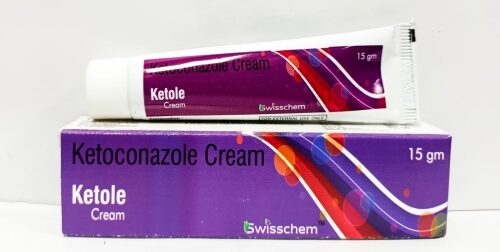
Ketoconazole Cream
KETOLE CREAM
Description
Ketoconazole 2%w/w (Cream Base) – Ketoconazole is used to treat yeast or fungal infections. It works by killing fungi or yeast or stopping their growth.
Ketoconazole cream is used to treat:
- Athlete’s foot (tinea pedis; tinea pedis);
- Ringworm of the body (tinea corporis);
- Ringworm of the groin (tinea cruris; jock itch);
- Seborrheic dermatitis;
- “Sun fungus” (tinea versicolor; multicolored powdery mildew); And
- Yeast infection of the skin (cutaneous candidiasis).
How To Use Ketoconazole Cream
- This medicine is for external use only.
- Wash hands only before use.
- Do not use it on healthy skin or large areas of skin.
- Keep this medicine out of your eyes.
- If so, rinse thoroughly with cold tap water. Use it as directed on the label at the same times each day.
- Do not use it more often than directed or for longer than prescribed by your healthcare team. Continue taking the medicine until your healthcare team tells you to stop.
- On the afflicted area, apply a thin layer and gently rub it in. Do not bandage or wrap the area to be treated unless otherwise instructed by your healthcare team.
- Talk with your healthcare team about using this medication in children. Special attention may be required.
- If you think you have taken too much of this medication, contact a poison control center or emergency room immediately.
Benefits Of Ketoconazole Cream
Some potential benefits of ketoconazole cream include:
Antifungal effects: Ketoconazole is an antifungal medication that is effective against a variety of fungal infections, including ringworm, athlete’s foot, eczema, and yeast infections such as candidiasis.
Reduces itching and redness: The cream can reduce itching, scaling, and redness associated with fungal skin infections, helping to reduce discomfort and improve the appearance of affected areas.
Treatment of seborrheic dermatitis: Ketoconazole cream is also used to treat seborrheic dermatitis, a common skin condition that causes redness, itching, and peeling on the scalp and other areas of the body.
Convenience: The cream’s formula allows for easy application to the affected skin area, making it convenient for the treatment of fungal infections.
Prescription and over-the-counter availability: Depending on the strength and formulation, ketoconazole cream may be available in both over-the-counter and prescription forms, providing accessibility for those with different needs. Together.
Side Effects Of Ketoconazole Cream
- Irritation
- dryness or
- redness of the treated skin.
- stinging
- swelling
- Itching
Precautions Of Ketoconazole Cream
- Tell your doctor and pharmacist if you are allergic to ketoconazole or any other creams, or shampoos.
- If you use the cream, tell your doctor if you are allergic to sulfites.
- Tell your doctor and pharmacist about the prescription and nonprescription drugs, vitamins, nutritional supplements, and herbal products you take.
- Your doctor may need to change your medication dosage or monitor you carefully for side effects.
- Tell your doctor if you have or have ever had any medical problems.
- If you plan to use the cream, tell your doctor if you have or have ever had asthma.
- Inform your physician if you are nursing a baby, intend to get pregnant, or are already pregnant If you become pregnant while using ketoconazole, call your doctor.
Frequently Asked Questions
Q: How does the Ketoconazole molecule work to eliminate stubborn skin infections like Athlete’s foot?
A: It acts as a potent antifungal medication that targets the fungal cell membrane effectively and eliminates the organism or inhibits its growth and stop them from spreading.
Q: Why do healthcare professionals advise against applying Ketoconazole cream to healthy or large areas of the skin?
A: Applying it to the afflicted area prevents unnecessary systemic absorption and prevents irritation. It ensures the medication works effectively on the actual fungal site.
Q: Does this medication offer relief from the inflammatory symptoms related to seborrheic dermatitis?
A: Yes, it works effectively to reduce the scaling, redness, and intense itching associated with seborrheic dermatitis by clearing the underlying fungal infection or yeast overgrowth.
Q: Why do I need to inform my healthcare professional about my medical history of conditions like asthma before using this cream?
A: informing about your previous health condition gives a clear understanding to the healthcare professional about the personalized medication based on the individual condition and requirement. Also, certain formulations contain sulfites, which may trigger an allergic reaction in sensitive individuals.
Q: Is there any chemical risk associated with abruptly stopping the usage of this cream before the prescribed duration?
A: Yes, stopping abruptly or skipping the usage allows surviving yeast to multiply, and it leads to a quick recurrence of the infection and potential future antifungal resistance.
Additional information
| Packing | 15GM |
|---|---|
| Unit | CARTON |
| GST | 12 |